

Instructional design and development theory and practice. The knowledge and skills required to select, revise, and apply instructional development models.
Far from being only more ADDIE, this course brings us through the entire process of conceiving, analyzing, designing, developing, and evaluating an instructional experience, touching on skills addressed in co-requisite courses such as IDE 712 and IDE 641.
Heavy emphasis is given to the conception and design of an instructional model for general or specific use. This was a hard concept for me to grasp and perform for two reasons: first, I was always taught in my work that ADDIE was the model, and how can one improve on that? Yet theoreticians in this field do not consider ADDIE so much a model as a paradigm for creating instruction. Many different models can take on the steps of ADDIE and accomplish them in the framework of a specific relationship and sequence of the parts of instruction. The second reason for my difficulty with models is that initially I confused the model with the development process. My first model draft looked like a process flow for developing a deliverable. Useful, to be sure, but not exactly a model.
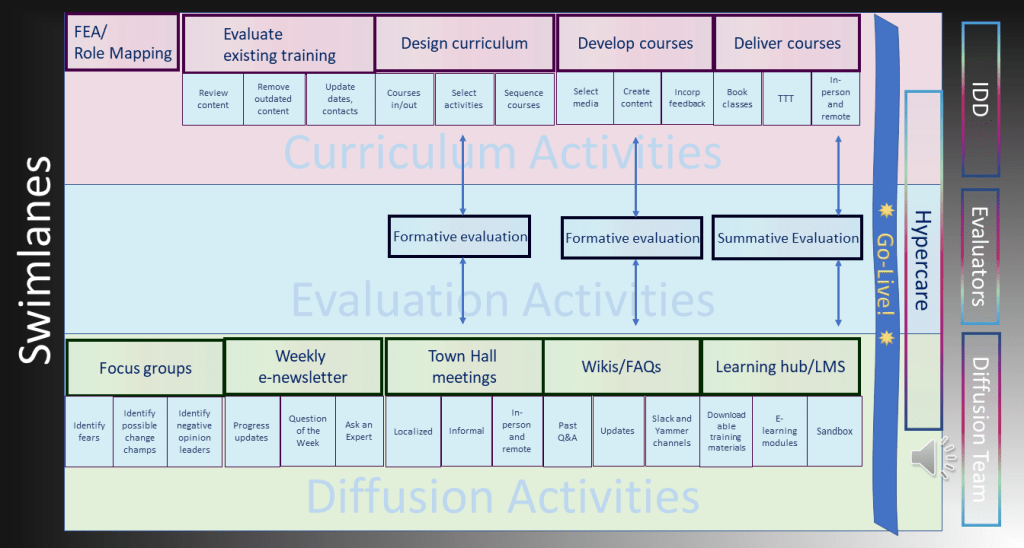
I settled on leveraging a concept from the business process documents (BPDs) we often encounter in SAP and other ERP implementations. For every single business task, a BPD includes a flow chart of upstream steps, the process steps and roles that accomplish them, and the downstream steps that are fed by the business task that is being laid out. Swimlanes are a common way to lay out processes in Visio or another process flow tool. The SAP BPDs contain info on every single possible permutations and decision point in a process, along with who is responsible (those are the swimlanes). I modified the swimlanes to reflect my assertion that each of the teams in an instructional implementation should be moving together toward a common goal. I am usually on the curriculum team in the final model presented below.
When conducting an implementation of a new system in a workforce training environment, reactions and attitudes of the workforce (employees) who will be learning the new thing, whatever that thing is, are critical to take into account. As Kanter (2012) points out, adults confronted with change often feel a loss of face or competence when a task or activity they know very well (in some cases better than anyone, no doubt an endorphin stimulator) is being changed to something they do not know well and is out of their control. In addition, such learners often fear their workloads will increase, and in some cases it does. For these and other reasons, I give great importance to the activities done in the swimlane known as organizational change management (OCM), or as it was labeled in this course, diffusion. Kotter (1995) gives a good summary of the activities to do to successfully manage change in an organization. They are:
- Establish a sense of urgency
- Form a powerful guiding coalition
- Create a vision
- Communicate the vision
- Empower others to act on the vision
- Plan for and create short-term wins
- Consolidate improvements and create more change
- Institutionalize the new approaches
In my past assignments, sometimes my team is tasked with not only designing and developing instruction but also diffusion of the message. In other assignments, a third party is tasked with diffusion. As long as both parties are in alignment on what messages need to be communicated, to whom, why, and what mitigation strategies are to be employed in case there are laggards or resistors to change (“negative Nellies,” those openly adversarial to the change and the instruction thereof), learning activities and diffusion activities can run side-by-side in their swimlanes. From my experience, I can say with certainty that if two different organizations are carrying out the curriculum activities and diffusion activities and are not in alignment, or are at odds with one another for any reason, the effort will fail.
On another page in this site, you can read my reflections on conducting evaluation of the instructional materials. However, mention must be made of evaluation activities in my swimlane model. Formative evaluation can and should be a powerful tool during the development process. However, often overlooked is that it can also be a powerful tool in diffusion activities. Evaluators would do well to share their findings with both the diffusion team and the curriculum team as they (the evaluators) provide formative feedback. I envision the diffusion (OCM) professionals sharing the progress of the curriculum development with the audience, lending them assurance their concerns are being addressed as evaluators discover areas in which the instruction can be improved, and solutions are being developed to mitigate the fear of lack of control or empowerment, or the fear of increased workload. You’ll notice in my model, evaluation is in the middle lane and feeds into both of the other swimlanes. This was not an accident. I intend evaluation activities to not happen in a silo, or evaluators to be hypercritical scolds that only look for mistakes. Competent instructional designers gladly leverage the findings of the evaluators for not only accuracy and pedagogical value, but also a positive and easy change message.
Work Samples
Here ‘s the Swimlane Model as I presented it to the class and to the pseudonymous “Company H,” whose true identity can now be revealed: it is the Honeywell Corporation, whose SAP training program I’ve been working on since March 2022.
Activities read from left to right.
In addition, I posted the video below to present the swimlane model, based on my work with Honeywell. The rationale for the model and assumptions and risks are included along with the model. After I complete this degree, I will be going back to consulting with Honeywell, so I hope I am able to help them in modifying their training program.
Final Grade: A

Kanter, R. M. (2012, September 25). Ten reasons people resist change. Harvard Business Review. https://hbr.org/2012/09/ten-reasons-people-resist-chang
Kotter, J. P. (1995). Leading change: why transformation efforts fail. Harvard Business Review, March–April 1995 (59–68).
 Beth's Journey Through the Instructional Design Universe